ActiveNotes: rethinking the medical record
Validating an electronic health record that lets physicians write structured and free-form notes in one place — the project where I first learned what HCI research was.
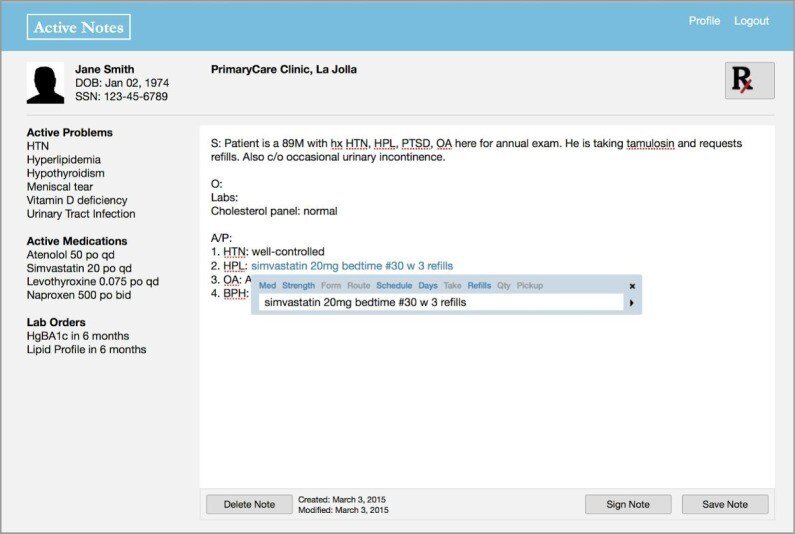
How might we integrate unstructured and structured data into a cohesive physician workflow?
Workflow inefficiencies like double documentation and constant context-switching don’t only undermine effective patient care — they also increase the risk of medical errors, the third leading cause of death in the United States.
To address this, the team at the Veterans Medical Research Foundation created ActiveNotes, a novel electronic health record system that enables physicians to create structured and information-rich free-form health information within the same application and screen. We tested and validated this proof-of-concept of an interactive electronic health record system in a clinical setting.
Who: Nadir Weibel, Zia Agha, Adam Rule, Steven Rick, Michael Chiu, Phillip Rios, Shazia
Ashfaq, Alan Calvitti
When: Sept. 2014 – Oct. 2015
Where: Veterans Medical Research Foundation, San Diego
Methodologies used: Interviewing, storyboarding, transcription, usability testing.
Tools: InqScribe (interview transcription), ChronoViz (~TechSmith Morae), UserZoom.
Physician workflow in patient documentation and order entry — my first HCI research.
I first learned about HCI research thanks to an opportunity with Prof. Nadir Weibel and Zia Agha in medical informatics, where we studied physician workflow in patient documentation and order entry forms.
Goal: To evaluate the potential of interactive clinical notes that enable physicians to create and store structured and free-form health information about patients.
Role: As a junior research assistant, my role was to accompany and assist the team with interviews, usability tests, transcriptions, and coding multi-modal video data. Interviews and usability tests would take place inside physician offices and in the middle of a workday, so as to preserve context and ecological validity in ways that a laboratory study would be unable to.
The GUI does not exist separately from the constraints of the social world.
Strict protocols, regulations, and standards of healthcare all constrain the design and usage of the GUI. That cultural scaffolding is something I wouldn’t have recognized without visiting the medical department and observing how physicians use EHRs in their own contexts.
A validated proof-of-concept, presented at AMIA 2015.
A validated proof-of-concept, featuring an interactive electronic health record system that can navigate both structured and free-form information within the same application and screen. The research was presented as part of the 2015 AMIA (American Medical Informatics Association) conference. You can find the full proceedings here.
Citation: Adam Rule, Steven Rick, Michael Chiu, Phillip Rios, Shazia Ashfaq, Alan Calvitti, Wesley Chan, Nadir Weibel, Zia Agha (2015). Validating free-text order entry for a note-centric EHR. In AMIA Annual Symposium Proceedings (Vol. 2015, p. 1103). American Medical Informatics Association.